Project period: November 2022 – October 2025
Location: El Wahat Bahareya Oasis, Western Desert, Egypt
Donor / programme: DEG Impulse / develoPPP (KfW/DEG)
Project summary
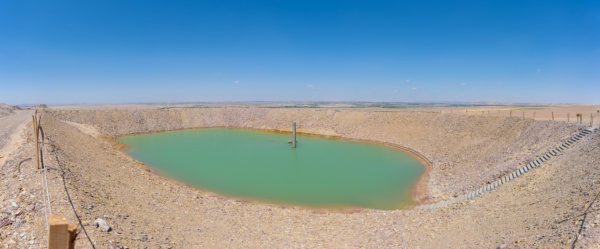
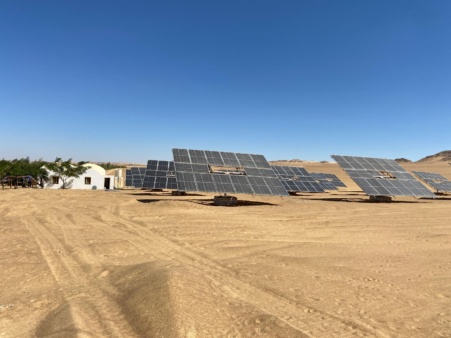
At SEKEM’s Wahat farm, we demonstrated an off‑grid, battery‑free irrigation approach that uses local topography as storage: solar PV pumps lift water by day into an elevated reservoir (~10,000 m³); at night, gravity feeds the center pivot so irrigation happens in the cooler hours—without diesel and without batteries. The concept reduces evaporation and plant heat stress and improves water productivity. A side‑by‑side field comparison of night irrigation versus day irrigation across wheat, basil, and beans showed consistent gains: typically 14–20% less water, 14–20% higher yields, and 24–30% less water per kilogram of final product (m³/kg).
Implementing partners & roles
- SEKEM for Land Reclamation (SLR) / SEKEM Holding – Lead implementer and farm operator; design, installation, operation, monitoring; commercialization track.
- Heliopolis University (HU) – Academic lead for research and capacity building; long‑term asset owner (pilot system transferred to HU at project end).
- Egyptian Biodynamic Association (EBDA / Demeter Egypt) – Partner for carbon crediting under the Economy of Love (EoL) standard and for farmer outreach.
- Center for Organic Agriculture in Egypt (COAE) & HU Carbon Footprint Center (CFC) – Verification/validation and carbon accounting support.
Objectives
- Demonstrate battery‑free night irrigation using solar pumping and elevation storage.
- Reduce irrigation water ≥20% and increase yields ≥10% at field scale.
- Build capacity and disseminate results through curriculum, trainings, workshops and media.
- Validate carbon credits and explore business models for replication.
Technology & site
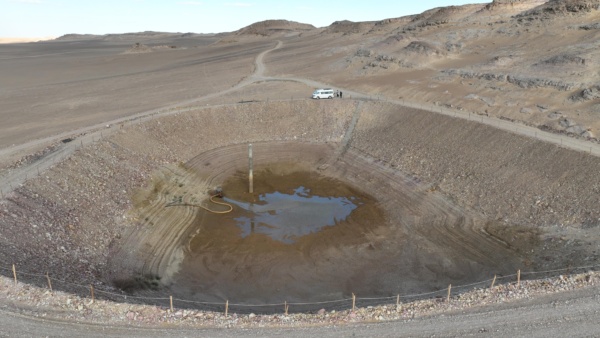
An elevated, lined reservoir (~10,000 m³) is located ~50–60 m above a ~23 ha pivot. A ~125 kW PV system pumps ~125 m³/h by day; irrigation uses gravity pressure at night. Digital flow meters and soil‑moisture sensors support continuous monitoring. The reservoir was initially sealed with compacted clay; after seepage persisted, a plastic liner was installed to ensure reliable storage.
Research design & methods
We ran an operational‑scale, season‑by‑season comparison of night irrigation versus day irrigation, instrumented for water flows and soil moisture with crop‑by‑crop yield recording. The first full season (wheat, winter 2023/24) already confirmed water savings and yield gains; subsequent seasons extended the analysis to basil and beans.
Research outcomes (night vs. day irrigation)
- Wheat (winter 2023/24): ~14% less water, ~14% higher yield, ~24% less water per kg of wheat.
• Basil (summer 2024): ~20% less water, ~14% higher yield, ~30% less water per kg.
• Beans (winter 2024/25): ~15% less water, ~20% higher yield, ~29% less water per kg.
• Basil (summer 2025): ~16% less water, ~18% higher yield, ~29% less water per kg.
Capacity building, learning content & dissemination
We created a five‑module course with 10–15‑minute educational videos (short films) per module, designed for mixed theory/practice sessions on site and online. Cumulatively, around 1,000 students and 11 trainers/teachers engaged in week‑long or longer courses and educational trips, aided by ERP‑linked field data collection. Awareness‑raising through educational visits and multi‑stakeholder workshops reached 615 participants from civil, private and public sectors.
Carbon pathway & financing (updated)
Water saved at the crop can be redirected to tree planting; combined with organic cultivation and renewable pumping, this enables Economy of Love (EoL) carbon credits that help finance replication. Over the project period, 2,083 EoL credits are attributable to the pilot (2023: 230; 2024: 876; 2025: 977). At a reference price of €25 per credit, this equals a theoretical total value of €52,075. Assuming 80% attribution to the farm, the potential additional farm income would be €41,660. Note: not all credits from Wahat have been sold; for 2023, 58% of generated credits had been sold (status 28.10.2025).
Commercialization & replication
The project prepares a commercialization track to identify partners and offers for farms with suitable topography in Bahareya and beyond, with a JV/consortium model envisaged. Assets are transferred to Heliopolis University at project end for ongoing research and education; operational data (water, yields, carbon) are integrated into ERPNext for traceability and analysis.
Capacity building, learning content & dissemination
Contact for adoption
Farms and institutions interested in assessing feasibility and carbon‑finance potential can contact the Egyptian Biodynamic Association (EBDA) for guidance and farmer services under the Economy of Love framework.